FAQ
Where is your manufacturing facility located, and what is your production capacity?
Our manufacturing facility is located in Hebei Province, China. We have a fully integrated, automated production line to ensure stable and scalable supply.
What are the main applications of your coconut shell activated carbon?
Our coconut shell activated carbon is widely used in: Water Purification (drinking/wastewater), Air Purification & Odor Control, Food & Beverage Processing (decolorization/purification), Gold Recovery, and as a catalyst or catalyst carrier in Chemical/Pharmaceutical industries.
Does coconut shell activated carbon require regeneration? How is it done?
Yes, saturated carbon can be regenerated. The most common industrial method is thermal regeneration, heating the carbon to 800-950°C in a controlled, oxygen-deficient atmosphere to burn off adsorbed impurities. This process requires specialized equipment.
What are the packaging and storage requirements?
Packaging:Standard 25kg bags with inner liner; 500kg/1ton Jumbo bags for bulk orders. Storage:Store in a cool, dry, well-ventilated place. Keep away from moisture, open flames, and strong oxidizing agents. Seal bags tightly after use.
What is your lead time, and do you provide samples for testing?
Standard lead time is 15-30 days after order confirmation. Yes, we provide free samplesfor testing; customers are responsible for shipping costs.
Is coconut shell activated carbon an environmentally friendly product?
Yes. It is made from renewable coconut shells (agricultural waste), aids in pollution removal, can be regenerated multiple times, and spent carbon is typically non-hazardous waste.
What certifications and documentation can you provide?
What is the expected service life of coconut shell activated carbon?
There is no fixed service life. It depends entirely on application conditions (contaminant type/concentration, flow rate, temperature). Life can range from months to over a year. A breakthrough test is the best way to determine replacement time.
How should spent (saturated) activated carbon be disposed of?
Disposal must follow local regulations. If it adsorbed hazardous materials, it is hazardous waste. For non-hazardous use, it can generally be landfilled. Consult a professional waste management company.
What are the special requirements for coconut shell carbon used in gold recovery
Gold recovery carbon requires: Extremely High Hardness/Abrasion Resistance, High Activity (Fast Adsorption Kinetics), and Uniform, Specific Particle Size(e.g., 6x12 or 8x16 mesh).
What safety standards apply to activated carbon for drinking water treatment?
Activated carbon for drinking water must meet stringent safety standards like NSF/ANSI 61(material safety) and NSF/ANSI 42(taste/odor/chlorine reduction) to ensure it does not leach contaminants.
Will you will attend the fair to show your products?
Yes, we actively participate in major industry exhibitions (e.g., Aquatech) to showcase our products. Please follow our website or contact sales for the latest schedule.
What is your core competitive advantage compared to other coconut shell carbon suppliers?
Our core advantages: 1) Vertical Integration(control from sourcing to production), 2) Product Customization(tailored iodine value, size, hardness), 3) Stable Supply(reliable raw material channels and sufficient capacity).
How do you ensure the sustainability and stable supply of your coconut shell raw material?
We source from multiple established suppliers in Southeast Asia and maintain strategic raw material inventory. This multi-channel strategy minimizes supply chain risks.
How is coconut shell carbon different from coal-based and wood-based carbon?
Key differences: Coconut shell:Microporous, highest hardness, best for small molecules (gases, gold). Coal-based:Mixed pores, versatile. Wood-based:Macroporous, softer, ideal for decolorizing large molecules.
After adsorbing toxic substances, can activated carbon release them, causing secondary pollution?
High-quality carbon, used within capacity, has strong adsorption and generally does not spontaneously release adsorbed substances, preventing secondary pollution. Desorption can occur under extreme conditions (e.g., high temperature).
Is there a quality difference in activated carbon made from coconut shells from different origins
Yes, shells from different regions vary in density, thickness, and impurities, affecting the carbon's hardness, ash, and pore structure. We select and blend raw materials for consistent, optimal performance.
Is there a service life indicator for activated carbon in household water filter cartridges? How to tell when to replace it?
There is no universal electronic indicator. Common methods: 1) Observe flow rate(decrease indicates clogging), 2) Check taste/odor(return suggests exhaustion), 3) Follow manufacturer's recommended schedule(e.g., every 6-12 months).
Is activated carbon a high fire risk? What precautions are needed for storage?
Activated carbon is a combustible solid. Fire risk is not exceptionally high under normal storage but requires precautions: store away from flames/sparks/heat, avoid dust accumulation, ensure ventilation, and do not store near strong oxidizers.
Are "regeneration" and "reuse" of activated carbon the same thing?
No. Reusemeans using the same batch for multiple cycles without regeneration (uncommon). Regenerationis a specific industrial process (usually thermal) that intentionally removes adsorbed substances to restore adsorption capacity for new cycles.
What special precautions are needed for activated carbon filters during shutdown periods (e.g., holidays)?
Key precautions: 1) Keep the filter bed submerged in waterto prevent drying (dried carbon + air = fire hazard). 2) If drained, purge with inert gas (e.g., nitrogen). 3) Consult system manufacturer for specific procedures.
We have a specific industrial wastewater with complex components. How to determine if activated carbon will be effective?
The most reliable method is a laboratory-scale adsorption test (isotherm) or pilot column test using your actual wastewater and our carbon. This determines capacity, contact time, and usage. We can assist in arranging tests.
For strategic clients with very large annual consumption, what deep cooperation models beyond standard orders can you offer?
For strategic clients, we offer: Annual Supply Agreements, Product Customization & Co-development, Consignment Stock/VMI, Joint Marketing & Technical Support, and Dedicated Account Management.
How effective is activated carbon for removing emerging contaminants (e.g., antibiotics, endocrine disruptors) from water?
Activated carbon is effective for many emerging contaminants (e.g., pharmaceuticals, endocrine disruptors) due to its high surface area and microporous structure. Effectiveness varies by contaminant properties. GAC in fixed-bed filters is a proven technology. We offer grades optimized for specific EC classes.
How to determine if spent activated carbon is classified as hazardous waste?
Classification depends on adsorbed contaminants. If it contains toxic heavy metals, certain organic toxins, or is from a hazardous process, it is likely hazardous waste. A TCLP testis the standard determination method. Consult a certified waste management agency.
Does activated carbon require "pre-treatment" before use?
New granular activated carbon (GAC) typically does not require pre-treatment. Powdered carbon (PAC) or use in ultra-pure water may need rinsing to remove fines. Always follow equipment manufacturer or our datasheet recommendations.
Besides unit price, what other costs should be considered when purchasing activated carbon?
Beyond unit price, consider: Adsorption Efficiency(higher may reduce consumption), Hardness(higher reduces losses), Bulk Density(affects shipping/filter volume), Service Life & Regeneration Costs, and Supplier Reliability & Support.
If our operating temperature is very high (or very low), does it affect the activated carbon?
High temperaturecan reduce adsorption capacity (adsorption is exothermic) and may cause desorption. Very low temperaturetypically increases capacity but may slow kinetics. Effects are contaminant-specific; consult our technical team.
Will your activated carbon performance degrade after storage? How to prevent it?
Properly stored in a cool, dry place, activated carbon has a very long shelf life (years) with minimal degradation. The main risk is moisture adsorption, which is usually reversible by drying. Keep original packaging sealed until use.
What specific optimizations does your carbon have for household/commercial water filter cartridges?
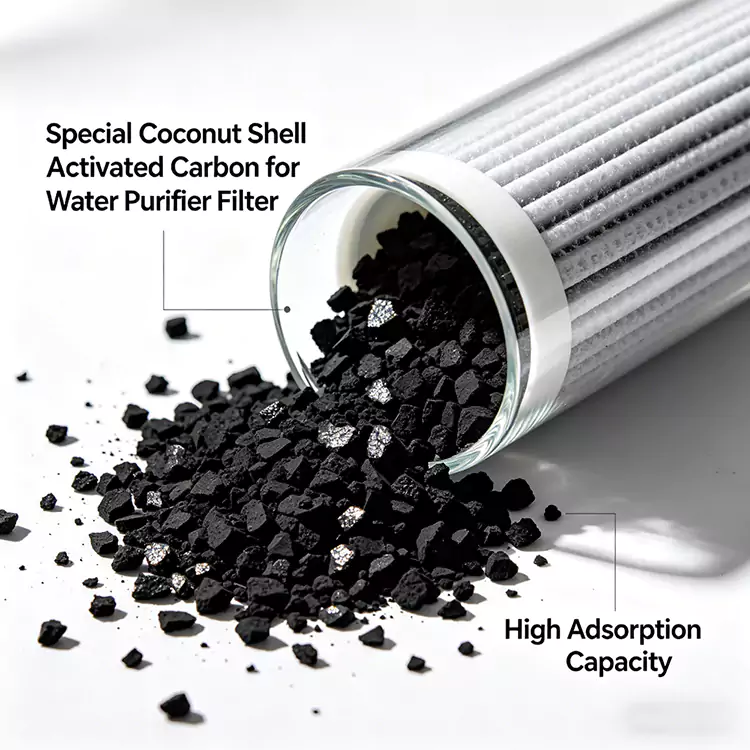
For filter cartridges, our carbon is optimized for: Low TOC Leachate, Low Ash Content, Optimal Particle Size Distribution, and High Chlorine Removal Capacity(for certain grades).
How to determine if the activated carbon is exhausted and needs replacement? Are there simple methods?
Simple determination methods: 1) Performance-based:Decline in treatment efficiency. 2) Time-based:Pre-determined operating time. 3) Pressure Drop:Significant increase indicates clogging.
If our demand grows rapidly, can you keep up with the supply?
Yes. We have scalable production capacity and strategic raw material inventories. We can implement phased production/delivery and work on long-term supply agreements to ensure reliable growth together.
How do you prevent moisture damage or packaging breakage during transit?
We use moisture-proof packaging (sealed bags with liner), ensure containers are clean/dry, and use desiccants and proper stuffing for sea freight. We work with reliable logistics partners and have a clear process for transit issues.
What is your MOQ?
Our standard MOQ is 1 metric ton. For sample orders or trial projects, we are flexible and can offer lower quantities.
Are you a trading company or a manufacturer?
We are a direct manufacturerwith our own factory, production lines, and R&D team, ensuring strict quality control, competitive pricing, and flexible customization.
What if we receive defective goods, or the quality doesn't match?
Contact us immediately with photos/videos and the batch number. We will investigate promptly. If confirmed our responsibility, we will provide a solution (replacement, compensation, discount) per our quality guarantee terms.
Is payment required in full before shipment? Are there more flexible terms?
For new customers, standard terms are 100% T/T before shipment. For established customers with good credit, we offer flexible terms (e.g., 30% deposit, 70% against B/L copy). Terms are negotiable based on order value and history.
News Recommendations